


Introduction
The main islamic dua before sleeping taught by the Prophet Muhammad ﷺ is: “Bismika Allahumma amutu wa ahya” — “In Your name, O Allah, I die and I live” (Sahih al-Bukhari 6324). It sits inside a short Sunnah routine: making wudu, dusting the bed, lying on the right side, and reciting a handful of authentic duas before closing your eyes.
If you want Islamic dua before sleeping copy paste, you are in the right place. Pick any message below, copy it and paste it straight into a text, a card or a social post.
This guide lists every sound (authentic) dua before sleeping with its Arabic text, transliteration, English translation, and exact hadith reference — plus the etiquette, common mistakes, and what to do after a bad dream.
Why Reciting Dua Before Sleeping Matters in Islam
Sleep is described in the Quran and Sunnah as a “minor death” — the soul temporarily leaves the body, and only Allah decides whether it returns at dawn. That is why the Prophet ﷺ never went to sleep without dhikr and dua.
Reciting dua before sleeping does three things: it renews tawakkul (trust in Allah) for the night, asks for protection from shayateen and bad dreams, and turns an ordinary daily act — sleeping — into worship that carries reward.
Ibn Abbas (RA) narrated that the Prophet ﷺ taught these words “as he taught them a surah of the Quran,” showing how seriously the Sunnah treats this habit (Sahih al-Bukhari 6311).
This is exactly why memorizing even one islamic dua before sleeping habitually changes how the whole night is spent.
Sunnah Bedtime Routine (Etiquette Before Sleeping)

The Sunnah bedtime routine follows a clear order: purify, prepare the bed, sleep in the correct position, then recite dhikr and dua. Follow these steps before your last dua of the night:
- Make wudu — the Prophet ﷺ said, “When you go to your bed, perform ablution like that for prayer” (Sahih al-Bukhari 247).
- Dust off the bed — shake out the inner part of the bed three times, since you don’t know what settled on it while you were away (Sahih al-Bukhari 6320).
- Lie on your right side — rest your right hand under your right cheek, following the Prophet’s ﷺ own sleeping position.
- Recite the tasbih of Fatimah — SubhanAllah, Alhamdulillah, and Allahu Akbar, 33/33/34 times (covered below).
- Recite the sleeping duas and Quranic verses — covered in the next two sections.
- Renew your intention to wake for Tahajjud or Fajr — the intention itself carries reward, even if you oversleep unintentionally.
Following this order is what makes an islamic dua before sleeping routine match the Sunnah precisely, not just approximate it.
Islamic Dua Before Sleeping: Arabic, Transliteration & Translation
The single most-recited islamic dua before sleeping is the one below — start here if you only learn one, then add the rest gradually.
1. Bismika Allahumma amutu wa ahya
Arabic: بِاسْمِكَ اللَّهُمَّ أَمُوتُ وَأَحْيَا
Transliteration: Bismika Allahumma amutu wa ahya
Translation: “In Your name, O Allah, I die and I live.”
Source: Sahih al-Bukhari 6324
The shortest dua before sleeping in the Sunnah, and the easiest for children to memorize.
As the shortest islamic dua before sleeping in this list, it’s the one worth memorizing first.
2. Bismika Rabbi wada’tu janbi
Arabic: بِاسْمِكَ رَبِّي وَضَعْتُ جَنْبِي، وَبِكَ أَرْفَعُهُ، فَإِنْ أَمْسَكْتَ نَفْسِي فَارْحَمْهَا، وَإِنْ أَرْسَلْتَهَا فَاحْفَظْهَا بِمَا تَحْفَظُ بِهِ عِبَادَكَ الصَّالِحِينَ
Transliteration: Bismika Rabbi wada’tu janbi, wa bika arfa’uhu, fa in amsakta nafsi farhamha, wa in arsaltaha fahfazha bima tahfazu bihi ‘ibadaka as-salihin.
Translation: “In Your name, my Lord, I lie down, and in Your name I rise. If You take my soul, have mercy on it, and if You send it back, protect it as You protect Your righteous servants.”
Source: Sahih al-Bukhari 6320; Sahih Muslim 2714
This is another authentic islamic dua before sleeping recorded directly from the Prophet’s own words.
3. Allahumma khalaqta nafsi wa anta tawaffaha
Arabic: اللَّهُمَّ إِنَّكَ خَلَقْتَ نَفْسِي وَأَنْتَ تَوَفَّاهَا، لَكَ مَمَاتُهَا وَمَحْيَاهَا، إِنْ أَحْيَيْتَهَا فَاحْفَظْهَا، وَإِنْ أَمَتَّهَا فَاغْفِرْ لَهَا، اللَّهُمَّ إِنِّي أَسْأَلُكَ الْعَافِيَةَ
Transliteration: Allahumma innaka khalaqta nafsi wa anta tawaffaha, laka mamatuha wa mahyaha, in ahyaitaha fahfazha, wa in amattaha faghfir laha. Allahumma inni as’aluka al-‘afiyah.
Translation: “O Allah, You created my soul and You take it back. Its death and its life belong to You. If You keep it alive, protect it, and if You cause it to die, forgive it. O Allah, I ask You for well-being.”
Source: Sahih Muslim 2712
Reciting this islamic dua before sleeping puts trust in Allah into words each night.
4. Allahumma aslamtu nafsi ilayka (the “last words” dua)
Arabic: اللَّهُمَّ أَسْلَمْتُ نَفْسِي إِلَيْكَ، وَفَوَّضْتُ أَمْرِي إِلَيْكَ، وَوَجَّهْتُ وَجْهِي إِلَيْكَ، وَأَلْجَأْتُ ظَهْرِي إِلَيْكَ، رَغْبَةً وَرَهْبَةً إِلَيْكَ، لَا مَلْجَأَ وَلَا مَنْجَا مِنْكَ إِلَّا إِلَيْكَ، آمَنْتُ بِكِتَابِكَ الَّذِي أَنْزَلْتَ، وَبِنَبِيِّكَ الَّذِي أَرْسَلْتَ
Transliteration: Allahumma aslamtu nafsi ilayka, wa fawwadtu amri ilayka, wa wajjahtu wajhi ilayka, wa alja’tu zahri ilayka, raghbatan wa rahbatan ilayka, la malja’a wa la manja minka illa ilayka, amantu bikitabika alladhi anzalta, wa binabiyyika alladhi arsalta.
Translation: “O Allah, I submit myself to You, entrust my affairs to You, turn my face to You, and rely on You, out of hope and fear of You. There is no refuge or escape from You except to You. I believe in the Book You have revealed and the Prophet You have sent.”
Source: Sahih al-Bukhari 6311; Sahih Muslim 2710
The Prophet ﷺ said whoever recites this and dies that night dies upon the fitrah (natural state of faith), and he instructed that it be the last thing said before sleeping.
Scholars single this out as the islamic dua before sleeping to prioritize when time is short.
5. Allahumma Rabb as-samawati (protection dua)
Arabic: اللَّهُمَّ رَبَّ السَّمَاوَاتِ وَرَبَّ الْأَرْضِ وَرَبَّ الْعَرْشِ الْعَظِيمِ، رَبَّنَا وَرَبَّ كُلِّ شَيْءٍ، فَالِقَ الْحَبِّ وَالنَّوَى، وَمُنْزِلَ التَّوْرَاةِ وَالْإِنْجِيلِ وَالْفُرْقَانِ، أَعُوذُ بِكَ مِنْ شَرِّ كُلِّ شَيْءٍ أَنْتَ آخِذٌ بِنَاصِيَتِهِ
Transliteration: Allahumma Rabb as-samawati wa Rabb al-ardi wa Rabb al-‘Arsh al-‘Azim, Rabbana wa Rabba kulli shay’in, faliqa al-habbi wan-nawa, wa munzila at-Tawrati wal-Injili wal-Furqan, a’udhu bika min sharri kulli shay’in anta akhidhun bi nasiyatihi.
Translation: “O Allah, Lord of the heavens, Lord of the earth, Lord of the Mighty Throne, our Lord and the Lord of everything, Splitter of the seed and the date-stone, Revealer of the Torah, the Gospel, and the Criterion, I seek refuge in You from the evil of everything You will seize by its forelock.”
Source: Sahih Muslim 2713
On restless nights, this islamic dua before sleeping is the one specifically narrated for fear and unease.
| Dua | When to Recite | Source |
|---|---|---|
| Bismika Allahumma amutu wa ahya | Every night, first to memorize | Bukhari 6324 |
| Bismika Rabbi wada’tu janbi | While lying down | Bukhari 6320, Muslim 2714 |
| Allahumma khalaqta nafsi | While lying down | Muslim 2712 |
| Allahumma aslamtu nafsi ilayka | Last words before sleep | Bukhari 6311, Muslim 2710 |
| Allahumma Rabb as-samawati | On nights of fear or restlessness | Muslim 2713 |
Quranic Verses & Tasbih Before Sleeping
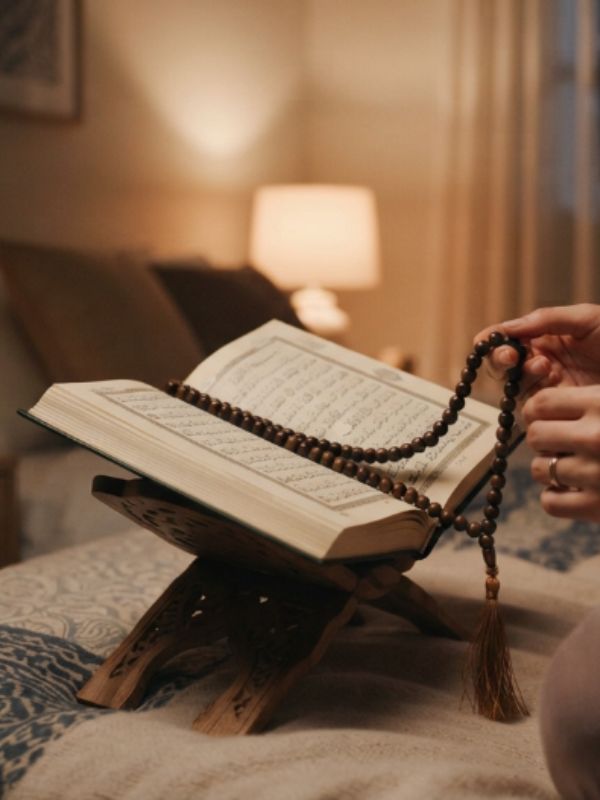
Beyond the spoken duas, the Prophet ﷺ recited specific Quranic passages and a fixed tasbih every night before sleeping.
Ayat al-Kursi (2:255)
The Prophet ﷺ told Abu Hurairah (RA) that whoever recites Ayat al-Kursi before sleeping will have a guardian from Allah, and no devil will come near him until morning.
Source: Sahih al-Bukhari 2311, 5010
Many scholars call Ayat al-Kursi the single most protective islamic dua before sleeping a Muslim can recite.
Last Two Verses of Surah al-Baqarah (2:285–286)
The Prophet ﷺ said, “Whoever recites the last two verses of Surah al-Baqarah at night, they will be sufficient for him.” Scholars explain this as protection from harm through the night.
Source: Sahih al-Bukhari 5009; Sahih Muslim 808
Pairing this with the shorter islamic dua before sleeping above rounds out the Qur’anic portion of the routine.
The Three Quls (Al-Ikhlas, Al-Falaq, An-Nas)
Method: Cup both hands together, recite Surah al-Ikhlas, al-Falaq, and an-Nas once each, blow gently into the palms, then wipe over as much of the body as you can reach — starting with the head and face — three times total.
Source: Sahih al-Bukhari 5017 (narrated by Aisha RA, describing the Prophet’s ﷺ nightly habit)
This method turns three short surahs into a complete islamic dua before sleeping ritual of protection.
Surah as-Sajdah and Surah al-Mulk
Aisha (RA) narrated that the Prophet ﷺ would not sleep until he had recited Surah as-Sajdah (32) and Surah al-Mulk (67). Al-Mulk is described elsewhere in the Sunnah as a protector from the punishment of the grave.
Source: Jami’ at-Tirmidhi 2892 (graded hasan sahih by al-Albani)
The Prophet’s ⿾ own nightly habit shows how central this islamic dua before sleeping practice was to him.
Tasbih of Fatimah (33-33-34)

Arabic: سُبْحَانَ اللَّهِ (×33) — الْحَمْدُ لِلَّهِ (×33) — اللَّهُ أَكْبَرُ (×34)
Transliteration: SubhanAllah (33 times), Alhamdulillah (33 times), Allahu Akbar (34 times)
Translation: “Glory be to Allah… All praise is for Allah… Allah is the Greatest.”
Source: Sahih al-Bukhari 5362; Sahih Muslim 2727
The Prophet ﷺ taught this to Fatimah (RA) and Ali (RA) as an easier alternative to a servant, saying it is “better for you both than a servant.” It is meant to be the very last dhikr before sleep.
Even without Arabic fluency, this tasbih works as an islamic dua before sleeping that anyone can count on their fingers.
Allahumma qini ‘adhabaka (protection from punishment)
Arabic: اللَّهُمَّ قِنِي عَذَابَكَ يَوْمَ تَبْعَثُ عِبَادَكَ
Transliteration: Allahumma qini ‘adhabaka yawma tab’athu ‘ibadak
Translation: “O Allah, protect me from Your punishment on the Day You resurrect Your servants.”
Source: Sunan Abi Dawud 5045; Jami’ at-Tirmidhi 3398
Recite this three times before sleeping, as taught to al-Bara’ bin ‘Azib (RA).
This closing islamic dua before sleeping is short enough to repeat three times without losing focus.
| Recitation | How Many Times | Source |
|---|---|---|
| Ayat al-Kursi | Once | Bukhari 2311 |
| Last 2 verses of Al-Baqarah | Once | Bukhari 5009, Muslim 808 |
| Three Quls | Once each, blown & wiped x3 | Bukhari 5017 |
| Surah as-Sajdah & al-Mulk | Once each | Tirmidhi 2892 |
| Tasbih of Fatimah | 33-33-34 | Bukhari 5362, Muslim 2727 |
| Allahumma qini ‘adhabaka | 3 times | Abu Dawud 5045 |
What to Do If You Have a Bad Dream or Can’t Sleep

A bad dream is from Shaytan — the Sunnah gives four steps, in order, the moment you wake from one:
- Seek refuge in Allah — say “A’udhu billahi min ash-shaytanir-rajim” (I seek refuge in Allah from the accursed Shaytan) three times.
- Spit dryly to your left — three times, without saliva.
- Change your sleeping side — turn over before going back to sleep.
- Don’t tell anyone the dream — the Prophet ﷺ said it “will not harm him” if these steps are followed and it stays untold.
Source: Sahih Muslim 2261
If you’re simply struggling to fall asleep or feel restless, repeat Ayat al-Kursi or “Allahumma Rabb as-samawati” (above) — both are specifically narrated for nights of unease, fear, or insomnia.
Falling back asleep after following these steps is part of a complete islamic dua before sleeping routine.
Benefits of Reciting Dua Before Sleeping
The Sunnah frames these as spiritual benefits, stated directly in the hadith — not medical claims.
- Protection through the night — Ayat al-Kursi and the Three Quls are described as guarding the reciter until morning.
- Reward even while asleep — dying “upon the fitrah” is promised to whoever recites “Allahumma aslamtu” as their last words.
- An easier alternative to a servant — the tasbih of Fatimah was given to Ali and Fatimah (RA) specifically to ease their daily burden.
- A structured, unhurried end to the day — wudu, dusting the bed, sleeping on the right side, and dhikr form a consistent wind-down habit distinct from any secular sleep-hygiene routine.
- A means of forgiveness — several of these duas explicitly ask Allah for maghfirah (forgiveness) and ‘afiyah (well-being) each night.
These benefits are exactly why an islamic dua before sleeping habit is worth building even five minutes at a time.
Common Mistakes to Avoid When Reciting Bedtime Duas
Skipping wudu out of tiredness. The Prophet ﷺ tied ablution directly to the dua routine — sleeping without it isn’t sinful, but it drops one of the Sunnah’s own conditions tied to the “die upon the fitrah” reward.
Reciting Arabic without knowing the meaning. Memorize the transliteration first if needed, but learn the translation early — the dua is a conversation with Allah, not a formula to repeat blindly.
Trying to do all ten duas every night. Imam an-Nawawi advised choosing what you can sustain rather than attempting everything and giving up after a few nights. Start with “Bismika Allahumma amutu wa ahya” and Ayat al-Kursi, then add more over time.
Losing count on the tasbih of Fatimah. Use your fingers or a tasbih counter — 33, 33, 34 is a fixed count, not “about 30.”
Telling others about a bad dream. This is explicitly discouraged in the hadith (see above) — it’s meant to be spiritually contained, not shared or interpreted casually.
Avoiding these mistakes keeps your islamic dua before sleeping routine consistent instead of abandoned after a few nights.
Frequently Asked Questions
What is the simplest islamic dua before sleeping?
“Bismika Allahumma amutu wa ahya” (“In Your name, O Allah, I die and I live”) is the shortest and most widely memorized, found in Sahih al-Bukhari 6324. It’s the easiest starting point for beginners and children.
What is the most important dua before sleeping?
Scholars point to “Allahumma aslamtu nafsi ilayka,” since the Prophet ﷺ instructed it be the last words spoken before sleep, promising death “upon the fitrah” for whoever recites it that night (Bukhari 6311).
Can I recite these duas in English instead of Arabic?
Yes — if you can’t yet read Arabic, reciting the translation is valid and better than not making dua at all. Aim to gradually learn the Arabic, since it’s the exact wording taught by the Prophet ﷺ.
What if I fall asleep before finishing all the duas?
There’s no penalty. Recite in this order — wudu, dusting the bed, right side, then the duas — so the most important ones (Ayat al-Kursi, “Bismika Allahumma amutu wa ahya”) come first, not last.
Is there a dua before sleeping for children?
Yes — teach “Bismika Allahumma amutu wa ahya” first since it’s four words and easy to repeat, then build up to Ayat al-Kursi as they grow.
Is reciting Ayat al-Kursi alone enough before sleeping?
It fulfills the specific hadith about having “a guardian from Allah” all night (Bukhari 2311), but the fuller Sunnah routine includes several duas — Ayat al-Kursi is a strong minimum, not a replacement for the rest.
What should I do immediately after a nightmare?
Seek refuge in Allah from Shaytan (three times), spit dryly to your left (three times), change your sleeping side, and don’t narrate the dream to anyone (Sahih Muslim 2261).
Does reciting dua before sleeping replace Isha prayer?
No. These duas are recited after Isha, as part of preparing for sleep — they are Sunnah supplications, not a substitute for any obligatory (fard) prayer.
Conclusion
Reciting islamic dua before sleeping turns an ordinary night’s rest into an act of worship — a habit the Prophet ﷺ never skipped, however tired he was. Start tonight with just two: “Bismika Allahumma amutu wa ahya” and Ayat al-Kursi, then build toward the full routine over a few weeks.
For more nightly Sunnah supplications, see our Good Night Dua and Blessings in Islam guide — and to round out your evening routine before this bedtime dua, read Good Evening Blessings: Quotes and Prayers to End Your Day with Peace.
Sources Consulted
- Du’a before Sleeping (List of Sound Hadiths) – Islam Question & Answer
- Duas Before sleeping with translation – IslamicFinder
- Sleeping Supplication – Fortress of the Muslim
- 3 Best Dua Before Sleeping At Night – MyIslam
- Dua Before Sleeping in Islam – The Dream Explainer
- 10+ Short and Powerful Duas to Recite Before Sleeping – The Muslim Vibe

3 thoughts on “Islamic Dua Before Sleeping: Sunnah Duas With Arabic, Transliteration & Meaning”